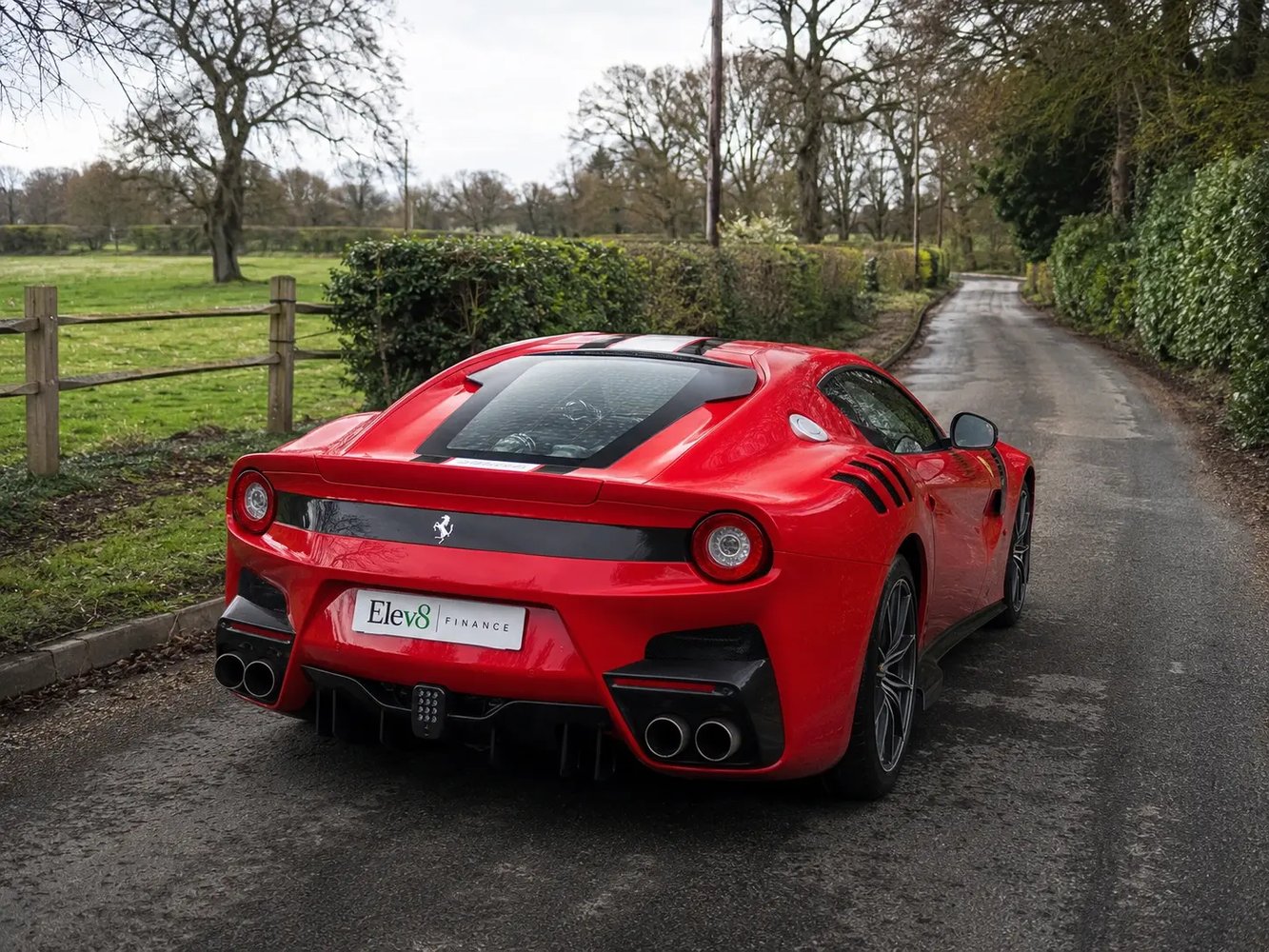
There are deals we structure that come together quickly, and there are deals that come together because the relationship has been there for years. The Ferrari F12 TDF we recently placed for a long-standing client of ours sits firmly in the second category - and the way we built it tells you most of what you need to know about how serious money moves at this level of the market.
The car was acquired without disturbing a single pound of cash. The deposit was funded by releasing equity against an existing car the client already owned outright - a vehicle that had been sitting on the drive, doing nothing, holding capital that was now better deployed into something appreciating faster. The structure on the F12 TDF itself was built around the asset, not around generic residual models. The client ended up with the car they wanted, the cash position they started with, and a finance structure calibrated to a Ferrari the market treats as an asset rather than a vehicle.
It is a way of acquiring cars that almost no one outside of specialist broking talks about - and one of the reasons clients who could clear seven figures in cash almost never do.
The Ferrari F12 TDF: 799 Built, the Car That Defined the Modern Allocation V12
The Ferrari F12 TDF is the hardcore, track-focused evolution of the F12 Berlinetta. Unveiled at the Finali Mondiali at Mugello in October 2015, production was capped at 799 coupes worldwide. There was no factory open-top version. It sits in a tight lineage of allocation-only, track-bred V12 berlinettas that runs from the 599 GTO before it, through to the 812 Competizione that followed.
The specification is unusual even by Ferrari standards. A 6.3-litre naturally aspirated V12 producing 769 brake horsepower at 8,500 rpm, 0 to 62 in 2.9 seconds, top speed beyond 211 mph. 110 kilograms lighter than the standard F12 through extensive carbon fibre. 30 per cent faster upshifts. 40 per cent faster downshifts. 87 per cent more downforce. No turbocharging. No hybrid system.
And then there is the Virtual Short Wheelbase. A rear-wheel steering system Ferrari developed specifically for this car - the first time the technology had ever appeared on a Ferrari road car. It changes the rear toe angle dynamically to mimic the agility of a shorter wheelbase. Ferrari liked it enough that they carried it forward to the 812 Superfast and the 812 Competizione as Virtual Short Wheelbase 2.0. But it started on the TDF.
That is the part that matters commercially. The F12 TDF is the car that defined the modern playbook for Ferrari's hardcore limited allocation V12 berlinettas. It is the middle chapter of a three-car run - the 599 GTO opened it, the TDF refined and codified it, the 812 Competizione closed it. Ferrari has not announced a direct successor in that specific lightweight, allocation-only, track-bred category. The 12Cilindri continues the naturally aspirated V12 in regular production. The Daytona SP3 sits in the Icona series, mid-engined, a different machine entirely. None of them is the next TDF.
Four factors are present on the F12 TDF that almost never align on a modern car. Fixed supply at 799, never to be expanded. The car that codified an engineering era now closed, with no comparable successor announced. The lineage from 599 GTO before it and the trajectory of the 812 Competizione after it, both of which have appreciated significantly. And the allocation barrier itself - buyers needed to have proven themselves as loyal Ferrari clients before being placed on the shortlist.
The market has priced all four in.
From Production Cars to Allocation Cars: Where Serious Money Is Moving
Across our client base and across our dealer partner conversations, the same pattern keeps showing up. The buyers operating at the top of the market are not chasing the latest production-line cars any more.
Five years ago, a serious prestige car budget would have gone largely into volume cars - 488s, 720S models, AMG and Porsche flagships. Beautifully made cars, fast, capable - but cars Ferrari, McLaren and the rest will build as many of as the market wants. That interest has moved on. The cars commanding attention now are the limited runs. The cars where the supply is fixed, the badge signals something the manufacturer cannot replicate, and the buyer was on a shortlist before they were on a delivery list.
The Ferrari F12 TDF sits in the middle of that conversation. So does the 812 Competizione that followed it, the 599 GTO before it, the Senna, the 765LT, the GT2 RS and GT3 RS in rare specifications. The pattern is consistent. Production cars depreciate, even spectacular ones. Allocation cars - especially those that codified a generation of engineering - historically have not.
It is the difference between buying the car and buying the badge the car carries.
What the Ferrari F12 TDF Is Doing in the Market
UK retail asking prices for clean, low-mileage F12 TDF coupes are sitting comfortably above the £900k mark, with strong, well-specified examples pushing into the £1.4m to £1.5m-plus range. The average sale price on tracked international transactions sits around the $1.5m mark.
The headline trade of recent months tells a clearer story. A 2017 F12 TDF sold publicly at Broad Arrow Auctions during the Amelia Island sale in March 2026 for $4.18 million - the strongest documented public result for the model to date, and a meaningful step above the previous benchmark of $3.19 million achieved at Mecum Kissimmee earlier the same year. Two seven-figure-plus public sales in eight weeks is not a quiet market.
The behavioural signal is the one to watch. Strong cars are being held rather than offered. Owners with the right specification, low mileage and clean history are reportedly turning down strong offers, choosing to wait rather than transact. That is not the behaviour of a market that thinks the car has peaked. That is the behaviour of a market treating these cars as long-term positions.
The dealer partners we speak with are reporting the same pattern - reduced supply at the top of the market, firmer pricing on the cars that do come available, longer hold times on the cars that have sold. The TDFs trading in the open market are increasingly the lower-mileage, single-owner, fully-documented examples. The rest are quietly held.
Why Equity Release Was the Right Way to Buy This Car
Here is where the deal we structured gets interesting. The client could have written a cheque. They have done it before on other cars. On this one they chose not to - and the reason matters.
Sitting in their existing garage was a vehicle they had owned outright for several years. Long-held, fully paid down, holding meaningful real-world value. From a balance-sheet view it was working capital frozen into a car. From a market view it was equity available to be released against, redeployed into a different position, and put back to work.
Equity Release does exactly that. We arranged finance against the existing vehicle - underwritten by a specialist lender on our panel who understands prestige cars as the assets they are - and used that to fund the deposit on the F12 TDF. The TDF itself was then placed on a Lease Purchase structure built around its specific position in the market, with the balloon configured against the realistic hold horizon for an appreciating asset rather than a generic depreciation curve.
The cash position never moved. The existing car kept its place. The TDF arrived. The structure works for the client because every component is calibrated to what the asset actually is, not what a generic finance template assumes.
This is one of the most powerful tools available at this level of the market, and it barely exists in mainstream finance commentary. The lenders we work with understand it. They underwrite it. They structure it. It is the kind of conversation specialist broking exists for - and it is the difference between a deal that fits the asset and a deal that fights it.
Why Finance, Not Cash, on a Seven-Figure Ferrari
It is the question we get asked most often when the deal crosses seven figures. The buyer has the capital. Why finance at all?
The answer sits across three commercial dimensions, and on the F12 TDF deal the client weighed each one.
Liquidity preservation
Seven figures of cash committed to a single car is seven figures unavailable for the next acquisition, the next opportunity, the next investment. The cost of finance over a three or four-year term, expressed as a percentage of asset value, is usually well within the opportunity cost of having that capital tied up. Sophisticated buyers price the trade-off and finance the car. It is the same calculation applied across asset classes - you do not sell down equity holdings to buy property, and you do not liquidate property to buy another car.
Asset-versus-cost asymmetry
When the Ferrari F12 TDF is appreciating at the rate the public auction results suggest, the gain on the asset offsets a material portion of the finance cost. In some cases on cars in this category, it has more than offset it. The buyer ends the term with a more valuable car than they bought, having effectively paid to use the capital rather than the car itself.
Tax and structural efficiency
For clients buying through a corporate structure, finance treatment differs materially from a straight cash purchase. We do not advise on tax - clients use their own advisors for that - but it is one of the considerations that almost always comes into the conversation, and one of the reasons specialist finance exists at this level.
Cars in this category are routinely financed even when they do not need to be. That is not a quirk. It is the entire point.
Ferrari F12 TDF Finance: Structure, Not Rate
Standard prestige car finance content leads on rate. APR comparisons, headline percentages, the cheapest monthly. None of that is the right conversation on a seven-figure collector Ferrari.
The conversation on a Ferrari F12 TDF is about structure.
Lease Purchase versus Hire Purchase. Balloon configuration set against the expected hold period rather than against generic residual models. Term length aligned to the client's broader plans for the car and for the wider garage. Exit options at maturity - refinance, settle, part-exchange into the next acquisition. Whether the deposit is fresh cash or released equity from elsewhere in the collection. Which lender on our panel has the strongest appetite for this exact car at this exact moment.
Mainstream lenders apply generic residual value models to specialist cars and price conservatively as a result. The balloon comes out wrong, the financed balance moves the wrong way, the structure does not fit the asset. Specialist lenders - the ones we place these deals with - price the car for what it actually is in the market. The structure reflects the reality. The economics work.
On a deal at this level, the cash difference between a generic structure and the right structure runs into the tens of thousands of pounds over the life of the agreement. That is what specialist broking exists to deliver.
A Long-Standing Relationship, Built Around the Asset
We do not share specifics on individual deals. What we will say is that the Ferrari F12 TDF in question has gone to a collector we have worked with for years, structured around Equity Release from an existing car they already owned, and the conversation about the next acquisition is already in progress.
It is the part of the business we are most proud of. Long-standing relationships with clients who take their cars and their finance equally seriously, who understand the asset, and who treat the structure of the deal with the same care they apply to the car itself.
If you are considering a Ferrari F12 TDF, or sitting on equity in a car you own outright that could be working harder, the questions worth asking are not about rate. They are about how the deal is built. How it sits against your wider asset position. Whether the lender understands the car. Whether the broker has the right relationships to place it properly.
Considering an F12 TDF?
Whether you are acquiring an F12 TDF or releasing equity from a car already sat in the garage, the structure matters more than the headline. The right funding should complement the wider picture, preserve flexibility, and be placed with lenders who properly understand these cars.
Have a chat with the team